


At some point in the evolution of every Shopify brand, the store becomes an anchor on your progress.
For some brands it happens around ten million. For the lucky ones it might not show up until twenty or twenty five. But it shows up.
When it does, no amount of great marketing outworks a weak post click experience. Your team can win pre-click and still lose the sale the moment the visitor lands.
Most brands misdiagnose that moment. They blame paid platforms, tracking, or the market. Then they do the most expensive thing with the least certainty.
They redesign.
This is not a moral argument about design. It is a control problem. You are operating inside unstable systems. Paid algorithms change. Costs rise. Attribution gets noisier. The one surface you can actually own is the store experience. If you don’t give it the deserved attention, you will keep paying a tax you never see.
Why ads keep getting harder, and why your store absorbs the damage
Ads are not going back to 2016. Or 2020. Or even 2024. This is the reality of ads right now:
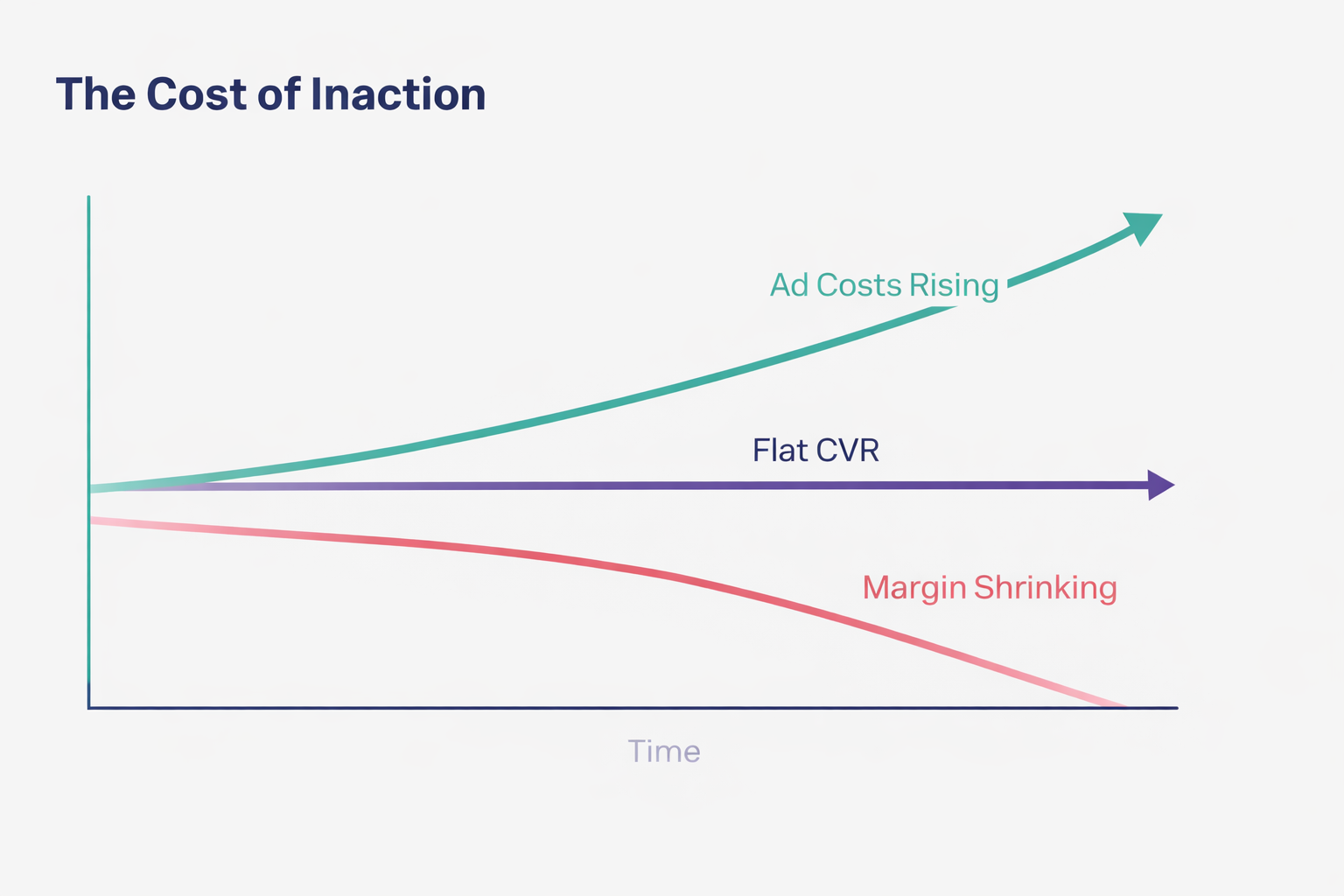
Competition increases, attention fragments, and every feed gets more crowded. That squeezes the margin. And when margin gets squeezed, your tolerance for inefficiency disappears.
Cold traffic and broader audiences hit the store first. Catalog complexity hits the store. New customer education hits the store. Return risk hits the store. The store becomes the absorber of everything upstream.
If your site is built only for high intent, pre-sold shoppers, you are set up to stall the moment you try to scale beyond your warmest pockets.
The three maturity levels most Shopify brands sit inside
When we look at how Shopify brands manage on site performance, they typically fall into three maturity levels.
Level 1: Gut feelings and Redesigns
This is the default state.
The team makes sporadic changes every year or two based on gut feel. There is no testing infrastructure. The problem with this approach:
- No clear understanding of site performance
- Reliant on in-platform metrics (Meta, Google, Shopify, etc)
- When performance suffers, fixing it becomes a matter of ego and opinion.
- No way of knowing which changes help or hurt. No A/B testing tool installed to aid.
And this is true for most Shopify brands:
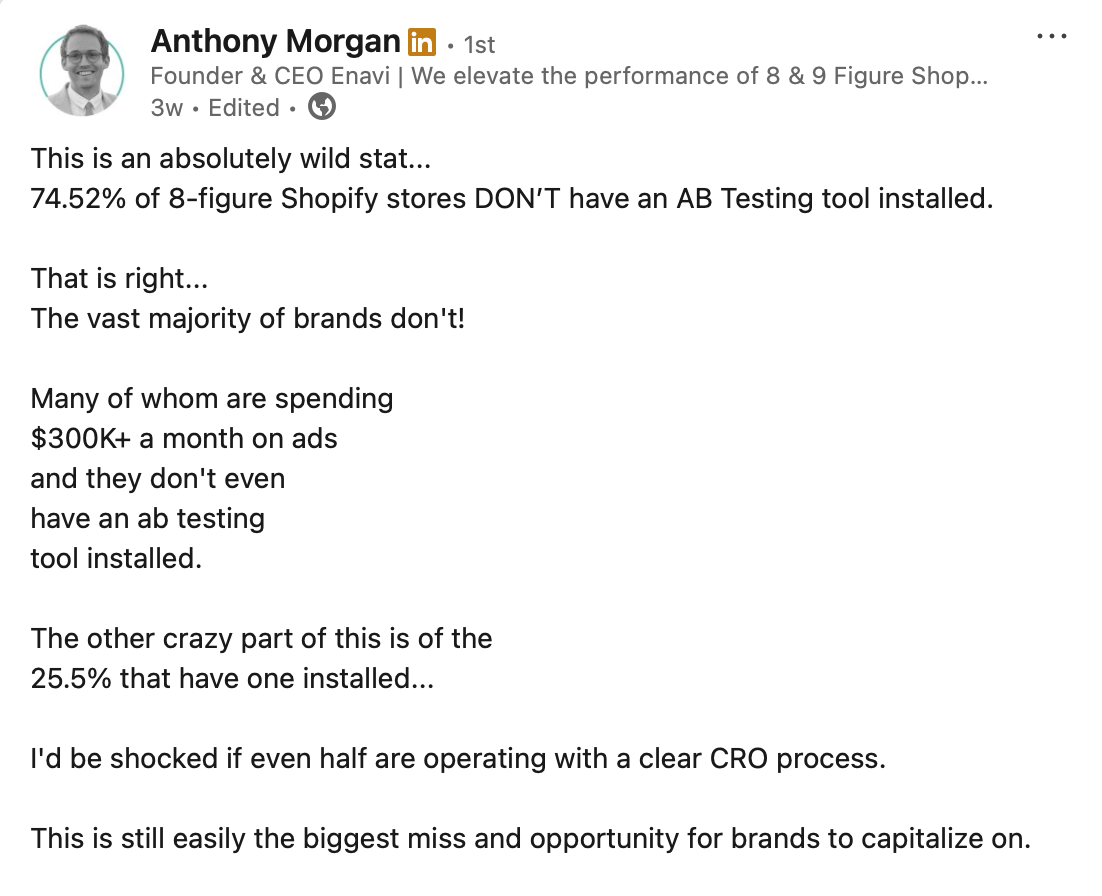
The fact that 74.52% of 8-figure Shopify stores don’t have an A/B testing tool installed reveals the uncomfortable truth. Most eight figure brands are still guessing on the most expensive surface of their business.
And most guesses do not win. In one of their articles, Convert mentions that nine out of ten tests are usually a failure. That is not a reason to avoid testing. It is a reason to stop shipping unvalidated changes directly to production.
Level 2: Self-Service A/B testing
This is a good starting point, but it will not get you to the next level of growth.
Around 18% of Shopify brands sit here. They have a testing tool, but not a testing system.
Most self service programs get trapped inside what the visual editor makes easy. Headline swaps. Button tweaks. Section order. You get motion. You do not get insight that changes decisions.
Here is what it looks like.
Challenges:
- It is easy to launch tests. It is hard to protect the program when real priorities show up.
- The roadmap becomes a grab bag. Effort feels high. Impact stays flat.
- You confuse running tests with building conversion knowledge. A tool can show winners. It cannot tell you what to test, why it matters, or what you learned.
Actions taken:
- You test functional UX elements like sticky Add to Cart, layout, social proof, upsells.
- You run them until the platform calls a winner.
- You ship it and immediately chase the next idea.
That loop is why you stall.
If your results do not change what you believe about the customer, your program is not compounding. It is just shipping UI changes.
Level 3: Strategic conversion rate optimization
This is where CRO stops being a queue of tests and becomes a growth system.
You are not chasing best practices. You are attacking the site with a repeatable method, grounded in actual intra-site funnel behavior.
Every experiment gives you insights, regardless of the outcome. It moves to a specific step in the journey. It proves or disproves a specific belief about the customer. It produces a learning you can reuse across the whole funnel.
The hard part is not the tool. It is discipline.
Challenges:
- Building the operating muscle to run this weekly, not when someone has time.
- Saying no to shiny ideas that do not map to the current constraint.
- Treating tests like a sequence, not a pile. You do not need to test everything. You need to test what matters in the right order.
What it looks like in practice:
- You identify the metric on fire using the intra-site funnel, then segment it by device and channel until the problem is undeniable.
- You run the 3i loop: insight, implementation, interpretation. The output is customer truth, not a screenshot of a lift.
- You turn those findings into better creative, better email, better offers, better landing pages. The site becomes your validation engine.
And even then, this is not the end goal.
Strategic CRO is the bridge.
The end game is growth experimentation that changes the business, not just the UI.
A quick self assessment, no excuses
If you are not sure which maturity level you are in, answer these honestly.
- When you ship meaningful changes, do you use a controlled split or holdout most of the time.
- What is your primary success metric for site work. Conversion rate, revenue per session, contribution margin, net profit margin.
- How many experiments did you run in the last 60 days that targeted one specific funnel behavior.
- Can you name your current metric on fire in the on site journey, and the single segment where it is worst. Device plus channel.
- Do you maintain a decision log that records what each test taught you about the customer.
- When a test wins, do you translate the learning into at least one other surface. Ads, email, landing pages, merchandising.
- What percent of tests are “editor easy” changes versus deeper offers, information architecture, merchandising logic, or risk reversal.
How Enavi breaks down Strategic CRO into three steps
If you are currently in Level 1 or Level 2, the move you need is not to run more tests. It is to build a system that turns your store into a reliable learning machine.
At Enavi, we break that system into three steps.
Step 1: Move beyond conversion rate with the Intra Site Funnel
Conversion rate is a deceptive metric. And you have no control of the conversion rate of your site. Too many things influence it to use it as a diagnostic tool.
So you need a more useful entry point. This is where the intra-site funnel comes into play. It focuses on behaviors, not an aggregate output. At a high level, there are four key behaviors in most Shopify journeys:
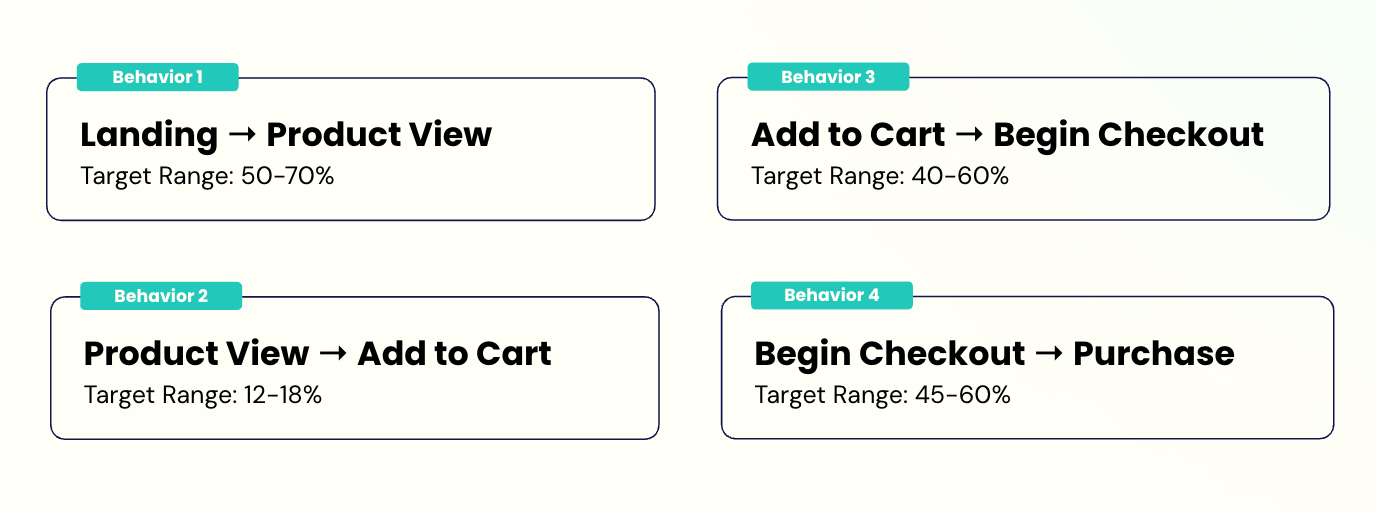
The ranges are directional. The power is in the method.
When you break the journey into behaviors, you can identify the metric on fire. Then you can zoom in by device, by channel, and by segment to isolate what is actually failing.
This is how you stop guessing.
If the mobile product view to add to cart is weak, you do not need a site wide redesign. You need to understand why mobile shoppers do not feel confident enough to commit.
If landing a product view is weak, you likely have a discovery problem, not a checkout problem.
If the add to cart to begin checkout is weak, you may have shipping shock, friction, or offer clarity problems.
Step 2: Learn how to learn from testing with the 3i loop
Most brands treat testing like a slot machine. Pull the handle, hope for a win, celebrate, move on.
That is why their results do not compound.
The point of testing is validating what you believe about customers. If you do not use testing to build customer knowledge, your program becomes a pile of disconnected outcomes.
The 3i loop forces discipline.
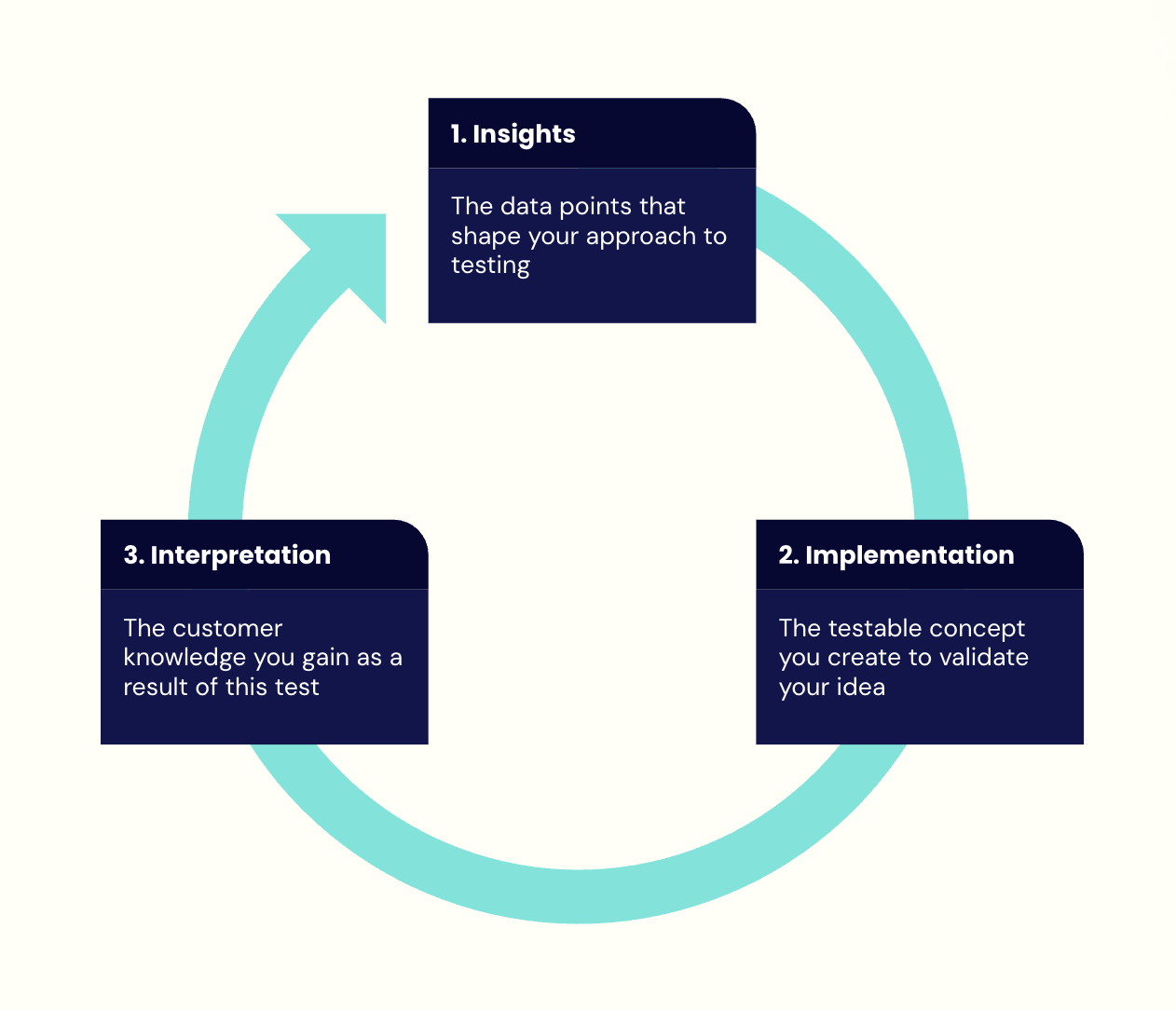
- Insights: start with a real insight from data or research.
- Implementation: turn the insight into a testable concept that targets the behavior you are trying to move.
- Interpretation: extract what the result teaches you about motivation, anxiety, decision clarity, and friction. Do not stop at “winner” or “loser.”
If your test result does not change what you believe about motivation, anxiety, or decision clarity, you did not run an experiment. You ran a design opinion with statistics.
The output you want is compounding customer knowledge that makes your next ten tests sharper than your last ten.
Step 3: 90 Days Growth Plans
You cannot solve everything in a quarter. But, you can make serious progress in a quarter if you stop scattering effort across the whole site. Ninety day cycles force focus. Focus forces depth. Depth produces real lifts.
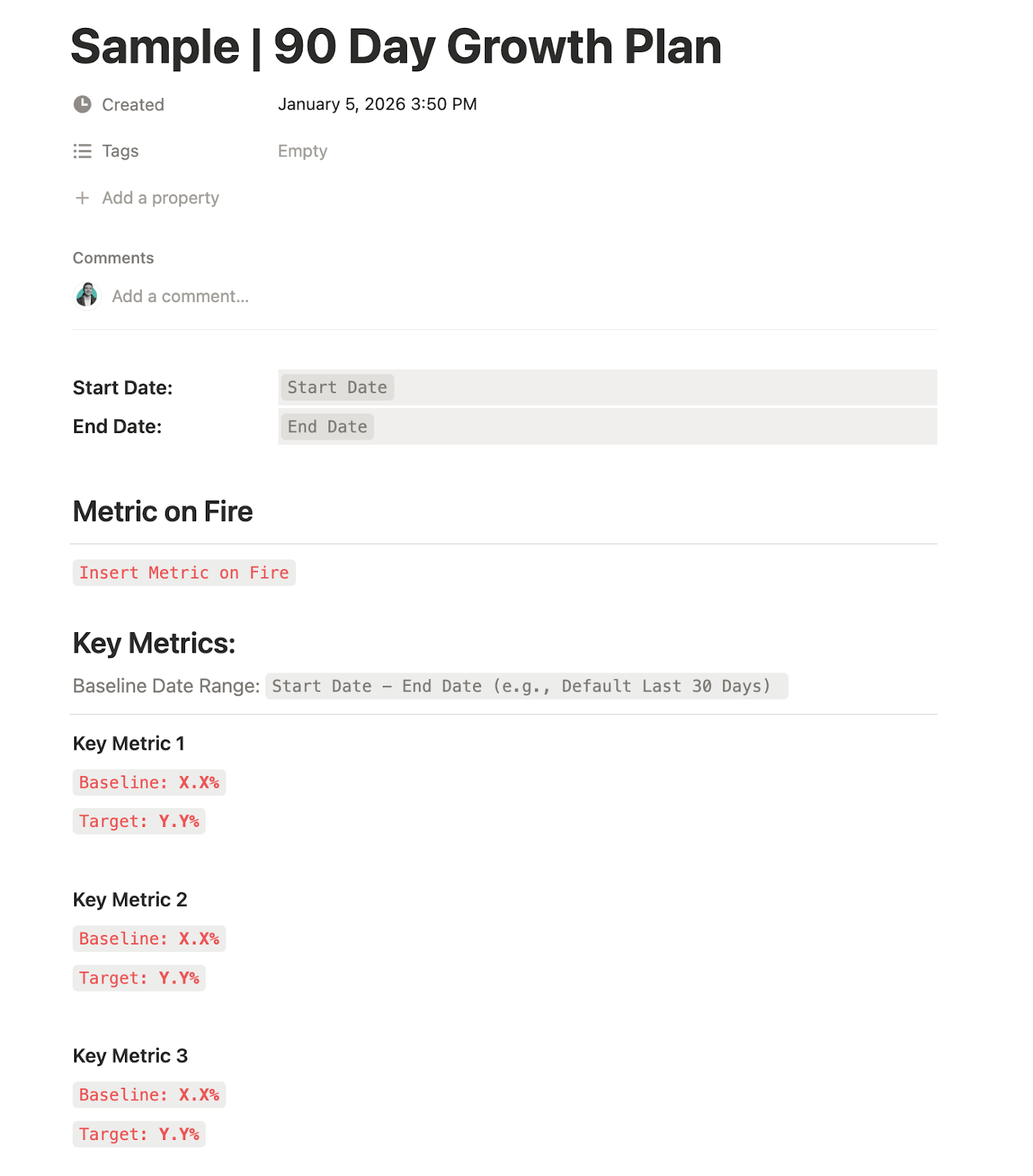
The simplest way to apply this is:
- Choose the metric on fire behavior from the Intra Site Funnel.
- Spend ninety days going deep on that behavior.
- Run a tight set of experiments that build on each other.
- Layer in qualitative research to explain the why behind the numbers.
- Then move to the next behavior.
The other upgrade here is metrics. Most brands worship conversion rate. Strategic programs pair behavioral metrics with business outcomes. A common progression is revenue per session, then contribution margin, then net profit margin. Otherwise you will celebrate growth that is actually discount driven, returns driven, or support load driven.
A real example from the Enavi roster
A brand came to Enavi with dreadful conversion performance and no clear understanding of how to fix it.
When we broke down the Intra Site Funnel, the failure was not everywhere. It was specific.
Mobile PDP to Cart behavior was massively below target (12%). Product pages were also underperforming when used as landing pages. Other segments were fine. That diagnosis did two things:
- It prevented a wasteful site wide redesign.
- It gave the team a clear focus: improve product page persuasion for cold mobile traffic.
From there we ran the 3i loop. We validated what new customers needed to see, and what could be removed without reducing confidence.
Then we ran ninety days of focused testing.
In ninety days the client increased average revenue per user by 25 percent.
Over time, continued systematic improvements drove much larger gains.
That is what compounding looks like. Not one big redesign. A system.
Conclusion
If your store is starting to feel like an anchor, stop reacting with chaos. Do not jump straight to a redesign. Do not buy more tools and call it a program.
Do this instead.
- Analyze your intra site funnel and identify the metric on fire.
- Segment the failure by device, channel, and landing page type until the pattern is undeniable.
- Build a ninety day plan to go deep on one behavior, stacking learning across experiments.
- Commit to interpretation so every result produces customer knowledge, not just a chart.
- Tie improvements to profit aligned north stars, not just conversion rate.
If you want a faster path, this is why Enavi built the Conversion Audit.
The audit breaks down your full funnel, identifies root causes of underperformance, benchmarks your key behaviors, and delivers tailored test concepts grounded in your actual store data. It also models realistic impact so you can make a decision like an operator, not like a gambler.
If you are serious about scaling profitably, your store cannot be the weak link.
Treat it like a system. Because if you do not, the market will keep charging you for it.

%201.svg)
